
Economic Development Strategic Plan (EDSP)
Riverside County’s Economic Development Strategic Plan (EDSP) is a five-year roadmap (2026–2030) designed to strengthen the local economy, enhance quality of life, and promote inclusive, sustainable growth across the region. The Plan outlines strategies to attract and retain jobs, support small businesses and entrepreneurs, guide public and private investment, and advance key industry sectors that drive long-term economic prosperity.
This Plan has been formally approved by the U.S. Economic Development Administration (EDA) and serves as Riverside County’s five-year Comprehensive Economic Development Strategy (CEDS). As defined by the EDA, a CEDS is a regionally driven, data-informed strategy developed through broad stakeholder collaboration to identify economic challenges, establish priorities, and implement actionable solutions that strengthen regional competitiveness and resilience.
Developed through an extensive, inclusive engagement process, the EDSP reflects input from local governments, business leaders, workforce and education partners, community organizations, and residents from across Riverside County. In addition to guiding local economic development efforts, the EDA-approved CEDS positions the County to remain eligible for federal funding and technical assistance programs that support infrastructure investment, workforce development, innovation, and economic resilience.

Riverside County Digital Economic Development Strategy (CEDS)
The Riverside County Digital CEDS is a dynamic, easy-to-use online resource with always-updated data. It shows how Riverside County is growing and where new opportunities are emerging. The Digital CEDS brings together information on jobs, housing, infrastructure, and key industries to help residents, businesses, and community partners understand the county’s economic direction. Unlike a traditional report, it is interactive and continuously updated, making it a useful tool for exploring trends, tracking progress, and supporting a stronger, more inclusive local economy.
Coachella Valley Region Economic Development Strategy
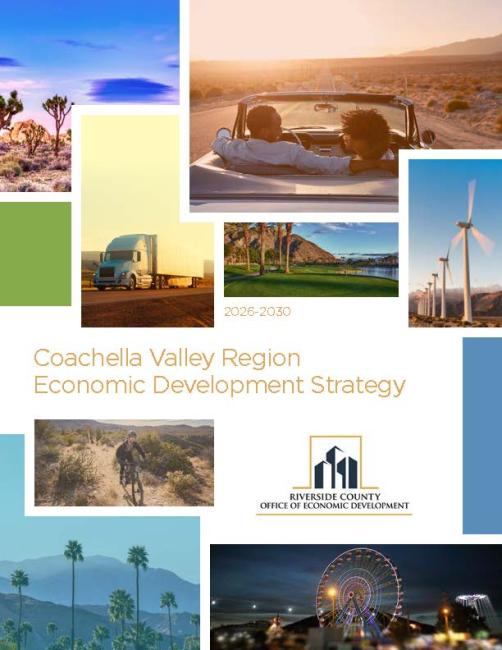
The Coachella Valley is entering a transformative era in its economic development journey. As a region renowned for its cultural vibrancy, agricultural legacy, and tourism appeal, it also faces complex challenges—from economic vulnerability and infrastructure gaps to disparities in economic opportunity and environmental challenges.
This Economic Development Strategy serves as a forward-looking roadmap to harness the Valley’s strengths while addressing its most urgent needs. It reflects a collaborative effort among local governments, tribal nations, community organizations, business leaders, and residents, and is grounded in the principles of comprehensive growth, sustainability, and resilience.
Engaging Stakeholders Across Riverside County to Shape the Plan
While developing the plan, the goal was to identify and refine key strategies to stimulate investment and elevate the county’s economic profile. The focus was to ensure that economic development initiatives created high-quality job opportunities and made resources accessible to all communities, especially those historically disadvantaged.
To achieve this, we held multiple stakeholder meetings to take a regional approach that was both data-informed and community-driven. These discussions supported a demographic and economic analysis of the county, helping us identify targeted industries and strategies to support a growing innovation and technology economy. From January through June 2025, we conducted 18 stakeholder meetings across Riverside County’s Northwest, Southwest, Pass Area, Hemet/San Jacinto, and Coachella Valley regions, engaging approximately 125 key stakeholders and business representatives. This was followed by community engagement meetings in October and November 2025, with six public review webinars. Together, these efforts ensured the plan was shaped by broad regional input and grounded in both data and community perspectives.